The Feel of a Word: stoush
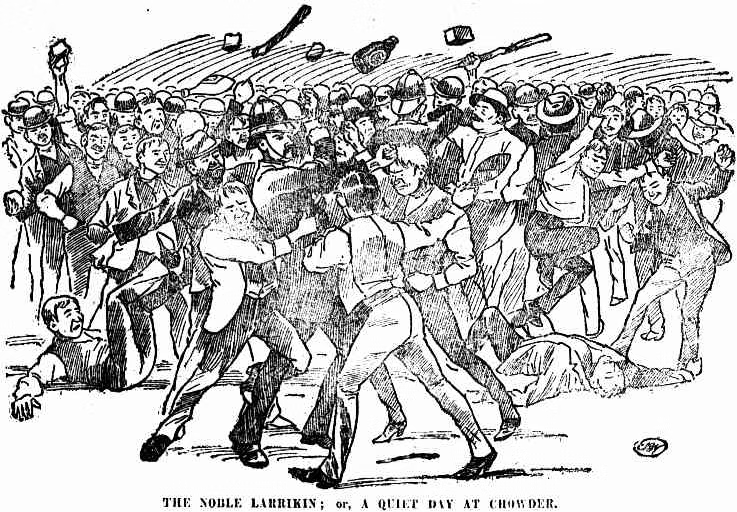
This is a word that appeared in the slang of street gangs of Sydney in the 1890s. The best guess is that it comes from the Scottish stashie a quarrel, uproar. The OED labels it as Australian and New Zealand, and British English ignores it. Initially it was used as a verb meaning ‘to punch someone’ or, even more violently, ‘to beat someone up’. The noun follows a little later for a street fight or violent brawl, or a punch or king-hit.
A gang like The Push determined who its leader was by such bare-knuckle fights. They stoushed people who got in their way, like the bricklayer who reported them for theft to the police.
‘The Push resolved to stoush him, and had lain in wait for a week without success.’
1911 Jonah Louis Stone
C.J.Dennis in Songs of a Sentimental Bloke makes the wry comment:
Wot’s just plain stouch wiv us, right ‘ere to-day.
Is “valler” if yer fur enough away.
From that lowlife beginning where you could give stoush, invite stoush, deal out stoush, the word moves into just slightly more respectable circles in boxing where mostly the fights were conducted according to the rules. They were fair dinkum stoushes. A boxer was a stousher, or a stoush merchant or artist. The common colloquial name for a boxing venue was house of stoush. To stoush someone was to knock them down and a stoush-up was a fight. To get stoushed was to be laid low by a superior fighter – or one who was prepared to use dirty tricks.
The following item from Truth (Sydney) 15 July 1900 reveals the uncouth nature of stoushing:
It is not absolutely necessary for our Naval Brigade to go to Chinkeyland to get stoushed by the ‘Boxers’, as they can be easily fixed up in this city. Let them get locked up at the Central on Saturday nights over the ‘booze,’ and worry the coppers for water early on Sunday morning, stoush will invariably follow quick and lively.
Stoush also enters more mainstream colloquialism as shown in the following:
One or two wanted to go back and “stoush” that landlord, and the driver stopped the coach cheerfully at their request; but they said they’d come across him again and allowed themselves to be persuaded out of it.”
1900 Over the Sliprails Henry Lawson.
I think the force of the quotation marks here is to show that this is an unusual colloquialism, hitherto an item of underworld slang, adopted by a group of middleclass respectable people who wish to talk tough, but are actually not going to go through with any violence.
The First World War was named The Big Stoush and soldiers reminisced about particular stoushes that they had taken part in. While stoush may have been used initially as the equivalent of punch-up, it rapidly took on the patina of active heroism.
Between the wars stoushes were either of the street or the boxing variety, but, post World War II, a stoush had been watered down to ‘a bit of biff’, something that a red-blooded male might engage in without being regarded as a complete thug. This notion of a good stoush as an acceptable thing for blokes moved across into sport as well, particularly Rugby League. There were those who disapproved of stoush and those who regarded it as part of the game, as shown in this match report:
Says the “Mudgee Guardian’s” Kandos correspondent:
On Sunday last (August 29), Kandos footballers had as visitors a team from Wallerawang. After a great game of stoush and football, the locals won both the football (26 points to 5) and the stoush (three knock-downs to one). This kind of sport does not appeal to the public. In our town we have really good lads, and they are going to be murdered by one or two who go on to the field with just one object in their heads – just to boast that “I kinged two of them”. If the game is to be played, let’s play it fair dinkum. There is plenty of stoush awaiting those stoush merchants in other parts of the world. It seems they prefer home comforts.
Lithgow Mercury 1943.
This ambiguity between hard play and within-the-standards-of decency play seems to operate still, although perhaps to a lesser degree than it used to.
In football stoush was also used to mean ‘defeat utterly’.
Easts Should Stoush Students
BACK to Suburbia ! It's club football on Saturday and look out for snags.
Sydney Sportsman 23 July 1932
The stoush in sport was ultimately a testing game involving a confrontation between two equally matched teams, not necessarily one that featured brawls and king-hits.
In the end stoush moved upmarket into finance and politics, transitioning in the phrase verbal stoush. The Financial Review seems to have adopted it as a favoured word in the 1990s with stoushes being reported between companies and the Tax Office and other regulatory bodies. Stoushes over contracts were common enough as well.
And everyone enjoyed a good stoush in politics. Even at the local level a ding-dong argument with your local council and with a school committee was an honourable thing. Being up for a stoush in this context implied that you had right on your side against a bullying authority and that you would stand up for what you believed to be just. In this sense stoush perhaps has the same mix, semantically speaking, of punch-up and righteousness that it had in the First World War. We seem, by and large, to have forgotten the history of violence and thuggery.