The Feel of a Word: swamp
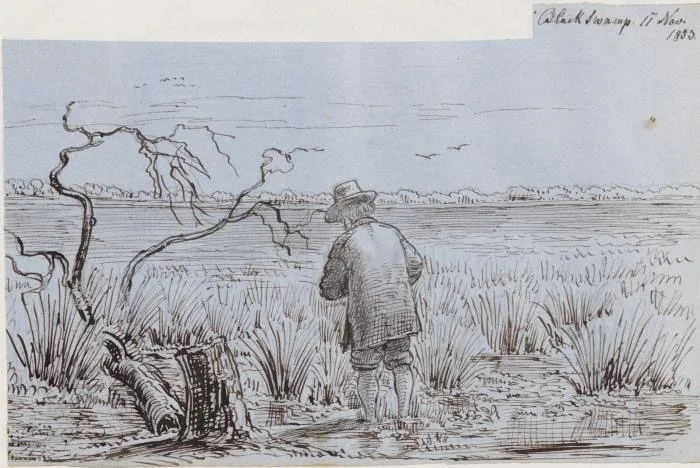
American landscapes are vast and varied but swamps do feature in them, although everyone agrees that the word is not theirs but existed in British English dialect and was related to sump in the sense of a drainage point. The earliest use of sump recorded in 1691 defines it as ‘a low hollow place in a part of a field’. So a sump or swamp was where the water pooled before draining away. Sump is a word that has its origin in old Germanic and has a base meaning of ‘sponge’ or ‘fungus’. The idea is that the swamp soaks up the water and holds it in depressions in the ground. The swamp may be near a river or creek but it is not connected and it is different from the billabong or waterhole that appears in an old riverbed and is fed by the same flow of water.
In the New World the word swamp appeared first in Virginia in the early 1600s. It was used as if it was a synonym for a marsh and indeed, one writer describes it as the local word for a marsh, that is, land which is fertile but, because it is low-lying, is covered with water and therefore cannot be cultivated. The distinction that seems to hold good in the US today is that a marsh is a water-saturated area or wetland, whereas a swamp is a wetland that is forested.
There are significant swamps in America so the word was attached to various other things related to swamps and appears in the naming of plants and animals that are to be found in the swamp.
This sense of a swamp transferred to Australia and is the name for a tract of land in which there are hollows that collect water, but also raised bits of ground where grass can grow, so that there is lots of vegetation at the water’s edge. The hollows have various names: gilgai, crabhole, melon hole, dead man’s grave, runaway hole. As in America it was impossible to use this land for cultivation but it was nonetheless valuable as a place to run cattle or horses where you could be confident of fodder and water being available even in the driest season.
A swamp paddock was a useful thing to have. There is an explorer’s account which mentions ‘a huge beautifully timbered, grassed and clovered swamp’ that accords with the American view. Swamp grass is a term that covered a variety of vegetation but it was good grazing for the bullocks.
Swamps were specified according to the vegetation that featured in them. Some of the common varieties were the ti-tree swamp, the paperbark swamp, the mangrove swamp, the lignum swamp. These all looked very different and were found in different parts of the country. Some of them, as, for example, the lignum swamp, were difficult to cross on horseback. The name lignum is a shortening of the botanical name Polygonum, a genus of plants with slender tangled stems, forming dense thickets in swamps. Another name for it is wireweed or knotweed.
The swamp plain, a flat stretch of water-saturated ground ringed by mountains, was to be avoided. The sensible rider stuck to the hills.
As in America the swamps supported a great deal of wildlife. There were swans, ducks and geese, turtles, crabs and crocodiles, and lots of frogs, goannas and snakes, mosquitos and sandflies. And larger animals such as the swamp wallaby, and larger trees such as the swamp gum or swamp oak (casuarina).
The swamp was distinguished in colonial writing from the bog. Travellers over the colonial landscape had to be wary of bogs and swamps. The swamps presented a difficult terrain but were clearly seen. The bogs were dangerous because they looked so innocent. There are stories of people on foot, on horseback or in a carriage, and even in a small plane, suddenly finding themselves sinking into ground that looked the same as the rest and was covered in vegetation but was a morass. And sometimes a bog featured quicksand.
Bog comes from a Gaelic word meaning ‘soft’. Bogs could be small or large, the small ones being called bogholes. There is a constant theme in Australian newspapers of requests to the local authority to fix bogholes that have formed in roads.
The term marsh is not so common in Australia but it does survive in placenames like Bacchus Marsh and in the term salt marsh for a swamp where the water is brackish. Saltmarshes occur near the coast usually in or behind sand dunes.
The word marsh comes from Old Norse and became part of the East Anglian dialect. It is a patch of alluvial soil found beside a river and well-watered, if occasionally flooded, and extremely fertile. It is what we would call a river flat. In England it was also called a water meadow.
A cowal is a swampy depression found in red-soil country. The word cowal is from the Kamilaroi language spoken through a large part of New South Wales extending into southern Queensland. It is an Anglicisation of the Kamilaroi word guwal.
An interesting kind of swamp is the hanging swamp, a swamp located in mountainous areas, especially around the headwaters of a creek, and often extending to the edge of the cliff line. There are a number in the Blue Mountains.
The shift to wetland as the preferred umbrella term occurred towards the end of the last century. With a growing interest in the environment there was a move to oust swamp (unpleasant, smelly, useless) and replace it with wetland (beautiful in its own way, habitat for birds and fish and all kinds of plants and animals). There was also a need for clarity in defining in the shaping of new environmental laws. The Australian government definition is that a wetland is an area of land where water covers the soil — all year or just at certain times of the year.
Wetlands include: swamps and marshes; billabongs, lakes and lagoons; salt marshes and mudflats; mangroves and coral reefs; bogs, fern and peatlands.