Callithumpian
Jeremy Butterfield, UK editor, in his latest blog produced a list of words from the OED with the suffix -arian. Among them was the amusing anythingarian which he defines:
anythingarian (before 1704; a person who has no fixed set of moral or religious beliefs). This is an appealing one, and probably describes a good half of British humanity these days. Though coined in the eighteenth century, its latest OED citation is from 2008. That said, in a corpus of 14 billion words, it’s vanishingly infrequent at two examples, both from the same illustrious or reprehensible source,…
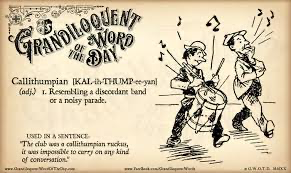
It reminded me of our wonderful word Callithumpian which Macquarie defines as ‘a person of vague religious beliefs, especially associated with a non-conformist religion’. Macquarie also suggests that it comes from the American use of Callithumpian dating back to the 1830s and referring to a noisy band of music makers. No one is quite certain of the origin of this word. It might have been a joke invention from the Greek kalli-, meaning ‘beautiful’, combined with thump. It might have been a variant of the British dialect Gallythumpian, one of a group of social reformers in southern Britain in the late 18th century who caused quite a stir at parliamentary elections, largely by being noisy and disruptive. Gally is a dialect word meaning ‘to frighten or scare with noise’; thump is how they did it. It is possible that the noisy street performers brought to mind the Gallithumpians for the Americans.
The first citation in the Australian National Dictionary for Callithumpian is dated 1872. The Gallithumpians were in decline through the 1800s. It was the introduction of the secret ballot in 1872 that made intimidatory tactics at elections a pointless strategy. But they had made enough noise, so to speak, through the century for Australians to be aware of them and somewhat disdainful of them. It is possible that we borrowed our word as a variant of Gallithumpian directly from the British use rather than in a roundabout way from the Americans. Not much is clear in all this etymologising, and, in particular, the link from noisy street musicians to people with vague religious ideas is not obvious.