titch
We were thinking about words to indicate a small amount and arguing about whether a tad was more or less than a titch. So the next step was to wonder where titch came from.
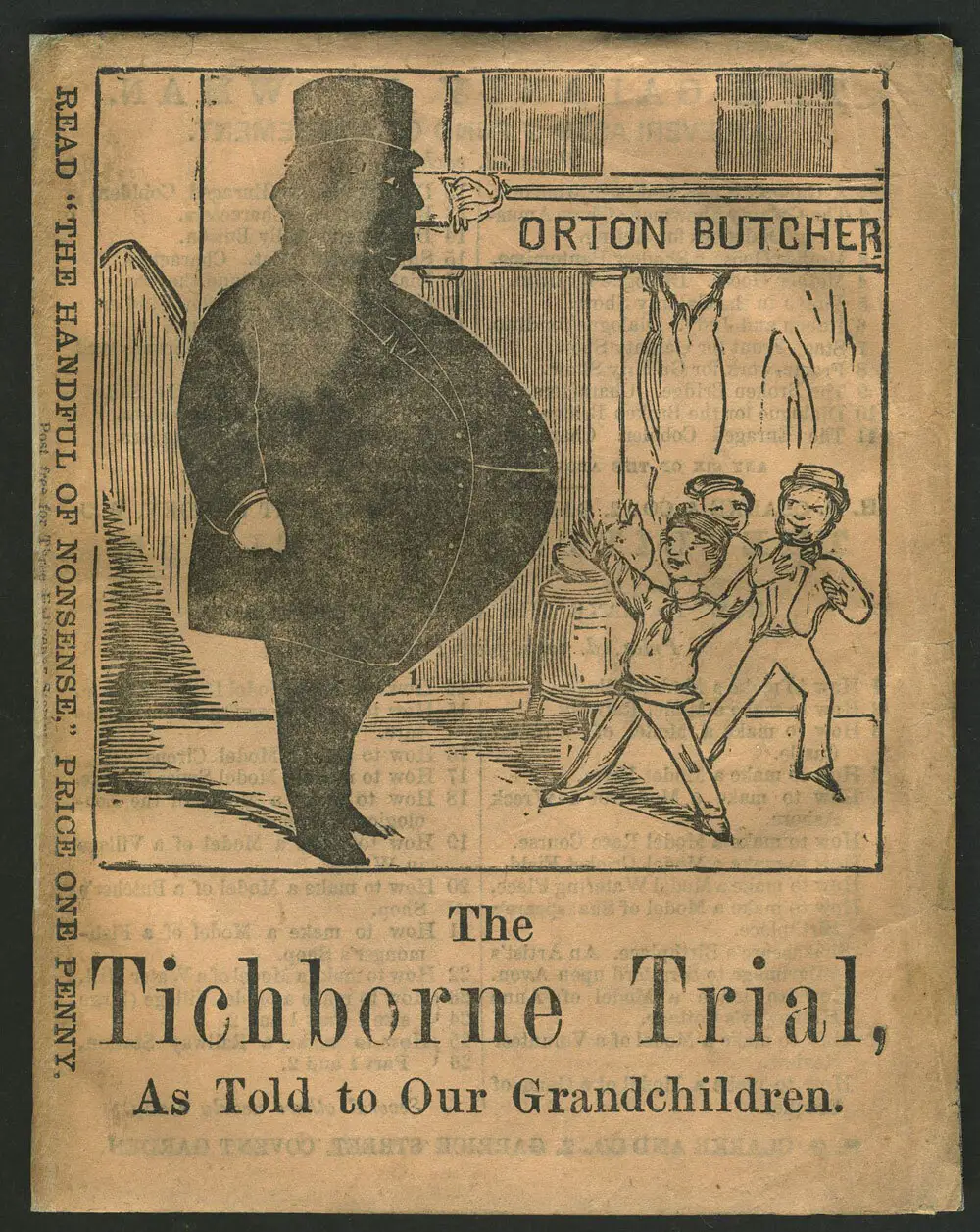
The Oxford English Dictionary has a complicated story for titch. They take it back to the Tichbourne Claimant, a butcher from Wagga Wagga who claimed to be the lost Earl of Tichbourne (in order to inherit). His case went to court and he was sent to prison in 1874 but before that there were some years in which the public at large debated the rights and wrongs of his claims. The Tichbourne Claimant, as he was known, was famous.
A London comedian, Harry Relph (1868-1928) adopted the stage name Little Tich because he was said to look like the Claimant. In my opinion Harry was considerably more attractive than the Claimant. Harry was of very short stature (4 foot 6 inches tall) and so the theory is that other short people, mostly children, were also called tich with the spelling changing later to titch.
The only difficulty with this is that the first two quotations in the OED, one from 1888 and one from 1917, refer to obese people. This is understandable because as the Claimant made the long trip from Wagga to London he put on a lot of weight, and then doubled that while he was waiting for his trial.
We get to the spelling titch referring to a young child in 1960 so there is a considerable gap between tich and titch both in spelling and meaning. The OED does not explain how the leap is made from an obese person to a young child.
I would prefer to argue that the 1960s titch is a dialectal variant of touch meaning ‘a small amount’. I’ll have just a titch. For the British adopting a dialectal form in colloquialism is always a mark of humour. The first quotation for titchy, the adjective from titch, is dated 1950 so that fits nicely into the timeline.
The expression a tad is not without its complications also. It is American, but again we may have two different lines of origin and meaning that have been mashed together. Tad, from taddie, from tadpole clearly dates back in American English to the 1830s where it was a humorous name for a young lad or small boy. But the leap from the small boy to the small amount is not clear and doesn’t happen until the 1940s. If the two were related you would expect this development of meaning to happen earlier than that.
It is possible that a tad meaning a small amount comes from tad in Somerset and Devonshire dialect meaning ‘load or burden’ and related to taddick a small amount or measure. The link to being a measure is why we always talk about a tad. A bushel, a pound, a tad. There is no reason why tadpole should give rise to a measure.
So both words have obscure origins. Personally I think that a tad is a bit more than a titch.